ai-fed, human-finished.
]]>Blog
-
Man found fatally shot in Back of the Yards
A man was found fatally shot in Back of the Yards Tuesday evening, according to Chicago police.
The man, 26, was found with a chest wound near the street in the 900 block of West 54th Street at 6:50 p.m., police said. He was taken to the University of Chicago Medical Center and pronounced dead, police said.
Police reported no arrests.
-
Man fatally shot on Near North Side
A man was fatally shot early Tuesday on the Near North Side, Chicago police said.
Javanti Smith, 40, was outside in the 400 block of West Evergreen Avenue around 2:10 a.m. when he was shot multiple times, police said.
The man was taken to Northwestern Memorial Hospital where he was pronounced dead, police said. His name was released Tuesday evening by the Cook County medical examiner’s office.
Area detectives were investigating.
-
Man fatally shot in North Lawndale alley
A man was found fatally shot Tuesday morning in North Lawndale, according to Chicago police.
Howaun Roberts, 20, was in an alleyway in the 3400 block of West Polk Street at 9:56 a.m. when he was shot multiple times, according to police and the Cook County medical examiner’s office.
He was taken to Illinois Masonic Hospital where he later died, police said in a statement. No arrests were reported.
-
Years marveling at this version of Pete Crow-Armstrong? ‘It’d be pretty special’ for Cubs
BALTIMORE — Pete Crow-Armstrong had a June for the ages.
His next trick? Well, it’s not slowing down.
The Cubs’ center fielder is off to the races in July, starting the month 6-for-12 in four games coming into Tuesday.
After batting .381 last month, he’s off to a .500 beginning to this month.
Yeah, yeah, small sample size. But still. The guy’s on fire.
“Obviously,” team president Jed Hoyer said toward the end of June, “he’s not going to play like this the whole season.”
Are we sure about that?
Crow-Armstrong’s teammates are still marveling, awestruck by the transformation the 24-year-old has made. He reached base at a .287 clip and walked just 29 times in 157 games last season. He carried a .383 on-base percentage into Tuesday and walked 41 times in his first 90 games this year.
“The most impressive thing is the plate discipline and the walks,” outfielder Ian Happ said Tuesday. “For him to get to this point this quickly and really, in a matter of a week or two, kind of change the way that he approaches at-bats and the patience, the ability to lay off some really tough pitches … that’s been the most impressive thing to watch is just the consistency of the quality of at-bats.
“There’s always been thump there. There’s always been unbelievable tools and the speed and the defense. What he did last year was so special. But … to watch the way that he’s walking, it makes him so lethal because he’s such a good base runner.”
And there’s a whole lot of career left for Crow-Armstrong, a long-term franchise cornerstone thanks to the contract extension he signed before the season that will keep him in a Cubs uniform through 2032.
Isn’t it worth wondering if the newly minted two-time All Star can reach even greater heights?
Or, given that his month of June put him in the same club as Babe Ruth, is that asking too much?
“If you bottled this player that he is right this second and gave him 15 more years of that, it’d be pretty special,” Happ said. “There’s always room to get better at things, but this version of him in the last month is pretty spectacular.”
Time for Taillon?
Righty starter Jameson Taillon could still return from the injured list prior to the All-Star break, but the Cubs hope they don’t have to bring him back that quickly.
Manager Craig Counsell said Tuesday the team is planning for Taillon to follow Sunday’s minor league rehab start with another. But should a need arise during the Cubs’ road trip to end the first half, they could bring Taillon back sooner for a “limited” outing.
That safety-net approach makes sense considering the Cubs’ experience with pitching injuries, including the hamstring strain that’s sidelined Taillon since early June.
More pitching updates
The Cubs are also waiting on recoveries from injured righties Edward Cabrera and Daniel Palencia.
Cabrera, down with his own hamstring strain, had a positive day of work Sunday. A recent update from Counsell projected a recovery period lasting slightly longer than Taillon’s, which has already lasted a month.
Palencia, meanwhile, is said to be making progress, with the Cubs expecting their closer to start throwing off a mound following the break.
And that injured position player
Utility man Matt Shaw tested his sprained left hand while taking swings last weekend. The Cubs will give him some more time before testing it again.
“There’s symptoms still,” Counsell said, “so we’re giving him another four, five days to rest and we’re going to re-test and go from there.”
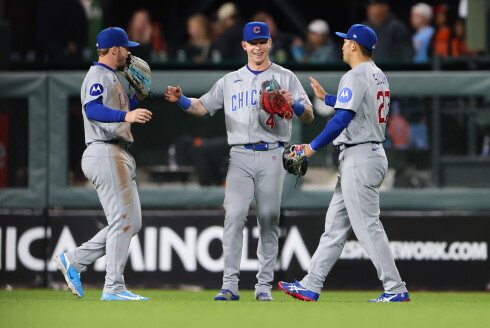 Slamming down and soaring up doesn’t make for the ideal landing to a flight. Nor does it make for the ideal pace of a baseball season. But the Cubs insist they’re built to handle the whiplash that has been their 2026 campaign so far.
 The Tuesday night meeting between the Cubs and Orioles, originally slated for a 5:35 p.m. Central first pitch, began in a weather delay.
 The lefty has a 5-1 record and earned his first MLB save last week.
 -
Munetaka Murakami goes 1-for-3 with two strikeouts in first rehab game
White Sox slugger Munetaka Murakami went 1-for-3 with a single and two strikeouts while playing five innings at first base Tuesday in his first rehab game at Triple-A Charlotte. There’s no set timeline for his return, but it’s plausible that he’s in the Sox’ lineup Friday for the opener of a series against the Athletics.
“There’s a game plan to build him up throughout the week,” Sox manager Will Venable said. “Take it day by day to see how he’s feeling and recovering and see if he’s getting enough at-bats. And then hopefully at some point before the break, we’ll activate.”
Venable has said he expects Murakami, who strained his right hamstring May 29, to play a couple of games in Charlotte. If that’s the case, Murakami could play Wednesday and travel Thursday to Chicago.
His return will necessitate a difficult roster decision. Jacob Gonzalez is playing well at first base and coming on at the plate. But there might not be playing time available elsewhere on the infield, where he actually has more experience.
“Every one of these guys has contributed,” Venable said. “We’ve been talking about that in every one of these wins, every one of these games. That makes it tough when you have guys that you’re bringing back and getting healthy because everyone has done such a good job. Good problems to have, but we’ll figure it out when we get there.”
Injury updates
With rain pouring and the field covered before the game Sunday in Cleveland, injured Sox outfielder Austin Hays ran sprints in right field under the supervision of trainer Brad Lawson. Hays is on the 60-day injured list with a strained left calf.
“He looked really good running, and so he’ll continue to run and take [batting practice], and then we’ll see how it goes over the All-Star break relative to being able to move around,” Venable said. “And then if he’s in a good spot, we’ll look at what a rehab assignment would look like.”
Outfielder Everson Pereira still is battling symptoms from a concussion. Venable described him as day-to-day.
“Still working through getting the intensity up with the activities without having symptoms,” he said.
Oh, Noah
Left-hander Noah Schultz had another rough outing in his second start since returning from the injured list (tendinitis in right knee). In five innings, he allowed four runs, seven hits (two home runs) and three walks with three strikeouts. In 10 starts this season, he has a 6.00 ERA (32 earned runs in 48 innings).
Signed to be the Sox’ closer, Dominguez is struggling to find the strike zone. Manager Will Venable explained why.Teel’s return, combined with the impending return of first baseman Munetaka Murakami, adds a big bat to an already-powerful offense that entered Monday tied for second in the majors with 125 homers.He extended his on-base streak to 15 games with a walk in the sixth inning of the Sox’ victory Sunday against the Guardians.Left-hander Chris Murphy is slated to open the game for the Sox, with right-hander Erick Fedde set to follow. Righty Tanner Bibee will start for the Guardians. -
East Garfield Park shooting leaves man dead
A man was fatally shot in a West Side alley Tuesday morning.
The victim was in the alley in the 3400 block of West Polk Street around 10 a.m. in the East Garfield Park neighborhood, when an assailant shot him multiple times, Chicago police and a Chicago Fire Department spokesperson said.
He was taken to Advocate Illinois Masonic Medical Center, where he was pronounced dead, according to police. His name, age and other personal information have not been released.
No arrests have been made.
Area 4 detectives are investigating.
-
NFL sets key dates for upcoming season
Agents and teams typically use the NFL Scouting Combine to do more than measure prospects — through conversations, they get a sense of the pending free agent market.
This season, the two sides won’t have to think too far back to those conversations. The NFL’s legal tampering window will open March 9, one day after the conclusion of the Combine. Typically, teams have at least a week between when they leave Indianapolis and when free agency begins.
The Feb. 14 Super Bowl in Los Angeles and April 29-May 1 draft in Washington, D.C., were previously set. The NFL announced other key dates for the upcoming season Tuesday:
• Aug. 30: Teams must whittle their roster to 53 players
• Nov. 10: Trade deadline
• Feb. 14: Super Bowl LXI in Los Angeles
• March 1-8: NFL Scouting Combine in Indianapolis
• March 9: Legal tampering window opens
• March 11: First day of the league year
• March 21: NFL’s annual meeting in Phoenix
• April 29-May 1: NFL draft in Washington, D.C.The NFL will hold its fall quarterly meeting in New York City from Oct. 20-21 and its spring quarterly meeting in Las Colinas, Texas, from May 25-26. Those could prove critical for the Bears, as owners need to vote to approve a stadium site once the team chooses one.
The Bears report to training camp at the end of this month.
 Williams sent the gift via Ambassador Brian Burch for the Fourth of July.Schlereth ripped Williams for struggling with the basics of the position and ranked him fourth in his draft class at this point.Wait, is this one of those “hit pieces” the online babies are always whining about?
 -
Navy Pier offers free Centennial Wheel rides following foggy Fourth of July fireworks show
Navy Pier is offering free rides on its Centennial Wheel every Wednesday through Labor Day after storms that rolled through the Chicago area made for a foggy Fourth of July fireworks show.
The free rides are available after 6 p.m. starting Wednesday for those who register, Navy Pier announced in a Facebook post Tuesday. Riders can secure up to four tickets per week.
“While we can’t control the weather, we can try to make it right,” the post states.
The special Fourth of July show that began at 10 p.m. was longer than the typical summer show at Navy Pier, had nearly twice as many fireworks and covered double the area along the lakefront.
But fog rolled in along the lake after Saturday’s afternoon storms and obscured most of the spectacle. In a late-night statement, Navy Pier said it was “disappointed with the effect fog had on tonight’s Independence Day Fireworks visibility and understand it impacted our guests’ experience.”
-
Hombre deportado por ‘error’ ha tenido dificultades para adaptarse tras regresar a Chicago
Como miles de inmigrantes capturados en el Operativo Midway Blitz del gobierno federal el otoño pasado, José Enrique Ojeda Duarte pasó siete meses en centros de detención antes de que funcionarios de Estados Unidos lo deportaran a Caracas, Venezuela, en abril.
Pero su historia tomó un giro cuando los agentes federales admitieron recientemente un error poco común, lo que llevó a un impactante regreso a Estados Unidos el mes pasado para este solicitante de asilo venezolano de 31 años. El gobierno afirmó que un error administrativo llevó a que Ojeda Duarte fuera deportado injustamente en un momento en que tenía varios casos legales pendientes que aún no se habían resuelto.
Aunque dijo que está “muy feliz de estar de regreso”, Ojeda Duarte ha luchado por adaptarse después de que su vida se vio alterada y soportó duras condiciones durante su detención. No puede dormir. Teme tanto que los agentes de inmigración lo arresten nuevamente que se muestra reacio a jugar afuera con sus hijos. Su familia dice que se ha alejado de sus seres queridos.
“Me siento constantemente nervioso de que me detengan otra vez”, contó Ojeda Duarte en su hogar de Chicago, reunido con su pareja y sus dos hijos. “A veces quiero llorar o me siento muy triste”.
El cambio del gobierno se produjo tras la intervención de sus abogados y de su decidida pareja, Leydimar Castillo, de 41 años de edad, quien unió múltiples batallas legales que finalmente aseguraron su regreso y su liberación. Castillo dejó de trabajar y comenzó a vivir de la ayuda mutua para mantenerse al tanto de cada desarrollo en todos los frentes legales desde su arresto.
“Para hacer lo que pasó aquí, tienes que esforzarte de verdad”, dijo Castillo.
Una batalla burocrática
Ojeda Duarte iba de camino al trabajo una mañana de septiembre cuando dijo que fue arrestado violentamente por agentes federales armados que “me agarraron, me sacaron del auto, me rasgaron la camiseta [y] me tiraron al suelo”.
Fue trasladado de un lado a otro a varios centros de detención, pasando la mayor parte del tiempo en condiciones “inhumanas” en Camp East Montana, en El Paso, Texas, dijo. La comida a menudo estaba congelada o caducada; no tuvo acceso a medicamentos cuando se enfermó de COVID; y apenas vio la luz del día.
“Los colchones: rotos”, comentó. “Nos trataron como perros. Todo estaba mal, incluso el agua. Nos estaban matando poco a poco”.
Ojeda Duarte ingresó legalmente a Estados Unidos durante la administración del expresidente Joe Biden en 2024. Había solicitado asilo y no tenía antecedentes penales.
Sin embargo, fue uno de los arrestados ilegalmente por agentes federales el otoño pasado, en violación del acuerdo de Castañón Nava, que prohíbe los arrestos migratorios sin una orden o causa probable.
Mientras sus abogados impugnaban la legalidad de la detención de Ojeda Duarte, un juez de inmigración también le negó el asilo bajo lo que se conoce como el acuerdo cooperativo de asilo, que permite al gobierno deportar a los migrantes solicitantes de asilo si no pueden demostrar un temor a regresar a su país de origen.
Uno de sus abogados, Afshan J. Khan, afirma que la denegación del asilo fue impugnada por su otro abogado de inmigración dos semanas antes de un plazo del gobierno, que legalmente debería haber pausado la deportación de Ojeda Duarte.
“No debería haber sido deportado en absoluto… porque tenía la apelación pendiente presentada a tiempo”, aseguró Khan.
En una inusual concesión legal, los abogados del gobierno admitieron en documentos judiciales que un error del sistema de datos dentro del sistema de Operaciones de Cumplimiento y Remoción del Departamento de Seguridad Nacional llevó a una deportación injusta. Pero Ojeda Duarte ya había sido deportado.
“Desafortunadamente, la remoción del solicitante fue un error inadvertido debido a un problema de calidad de datos dentro del sistema de información de casos del DHS-ERO (Departamento de Seguridad Nacional (DHS) y su oficina de Operaciones de Ejecución y Remoción (ERO)”, escribió el gobierno en la presentación. “Con base en la información disponible, ERO está trabajando diligentemente para iniciar el proceso de regreso del Peticionario a Estados Unidos”.
En respuesta a preguntas sobre el caso, un portavoz de DHS desvió la culpa hacia un programa de libertad condicional de la administración de Biden.
“Ojeda Duarte ingresó ilegalmente a Estados Unidos por la frontera sur en octubre de 2024 y bajo el desastroso programa de libertad condicional de la administración de Biden, fue liberado en el país sin ser investigado completamente y sin estatus legal para estar aquí”, decía el comunicado.
Claire Trickler-McNulty, quien trabajó con el Servicio de Inmigración y Control de Aduanas (ICE) durante más de una década antes del segundo mandato de Trump, afirmó en una entrevista que solía ver uno o dos casos al año en los que la agencia deportaba por error a alguien y tenía que traerlo de regreso.
Incluso hacer que este tipo de casos sea señalado requiere recursos y un abogado muy atento, dijo Trickler-McNulty.
“Necesitas que alguien insista bastante diciendo ‘no, no, esto está mal’”, agregó Trickler-McNulty. “Puede ser difícil, especialmente para personas que están fuera del país o que han sido removidas, incluso saber cómo plantear este tipo de problemas”.
Una lucha para salir de casa
Ojeda Duarte pasó más de un mes en Venezuela tras su deportación. Su repentina partida privó a su familia de su principal ingreso. Durante su detención, la familia se mantuvo en gran medida en la oscuridad mientras los funcionarios del gobierno retrasaban sistemáticamente las actualizaciones sobre su caso.
“Se me derrumbó el mundo”, aseguró Ojeda Duarte.
Cuando lo volvieron a traer a Estados Unidos, fue detenido en un centro de procesamiento en El Paso, Texas, durante aproximadamente dos semanas hasta que un juez federal ordenó su liberación. Pero su saga legal no ha terminado. Ahora está pasando por el proceso de apelación del asilo, que suele tomar meses o años.
Desde su regreso a Chicago, Ojeda Duarte ha tenido dificultades para retomar su antigua rutina. Cada mañana, se prepara para ir a trabajar en Indiana haciendo mantenimiento general de edificios. Pero salir de casa requiere un esfuerzo mental inmenso.
“A veces tengo una sensación terrible, como miedo a salir”, dijo Ojeda Duarte. “Que ocurra otro error, Dios no lo quiera. Tengo todos estos sentimientos de este constante sobrepensar y de los recuerdos”.
Castillo no creyó que su pareja realmente había vuelto hasta que lo abrazó. Pero después de que las lágrimas iniciales de su reunión se desvanecieron, una nueva y dolorosa realidad se asentó en su hogar del lado sur: Ojeda Duarte es un hombre distinto.
“Cuando regresa, se ducha, come y se va directo a la cama”, dijo Castillo. “La comunicación que solíamos tener ya no está, donde preguntábamos: ‘¿Qué hiciste? ¿Cómo te fue?’ Antes, solíamos sentarnos afuera y platicar, pero ahora no lo hacemos”.
Castillo afirmó que este viaje también ha sido agotador para ella, tanto mental como financieramente. Está buscando terapia para afrontar el trauma, un proceso de sanación que espera que su pareja comparta eventualmente.
Contribuyó: Sophie Sherry
Traducido con una herramienta de inteligencia artificial (AI) y editado por La Voz Chicago